Over time, an app becomes something no one can fully remember
When an app is first built, everything feels relatively clear. You remember why each feature was added, what purpose each screen serves, and how the overall structure fits together. The app exists vividly in your head.
But as time passes, things change. Features are added one by one, edge cases accumulate, and small operational tweaks pile up. The app gradually becomes more complex.
At that point, one important truth becomes obvious: the app is no longer something a person can fully hold in their memory. Even the original creator struggles to recall every flow accurately.
Shift in Thinking: Making changes is not about editing code—it’s about re-understanding the product
When a change request comes in, many teams immediately think about implementation. But what actually determines the difficulty of a change is not the complexity of the code.
The harder part is understanding where this request touches the app and how it connects to existing flows. Whether a feature stands alone or is deeply intertwined with others completely changes the nature of the modification.
That’s why the first step in any change is not altering code, but re-understanding the system as a whole.
Decision Criteria: What happens in a developer’s mind when they open the PRD?
When the PRD is opened, the thought process naturally becomes structured.
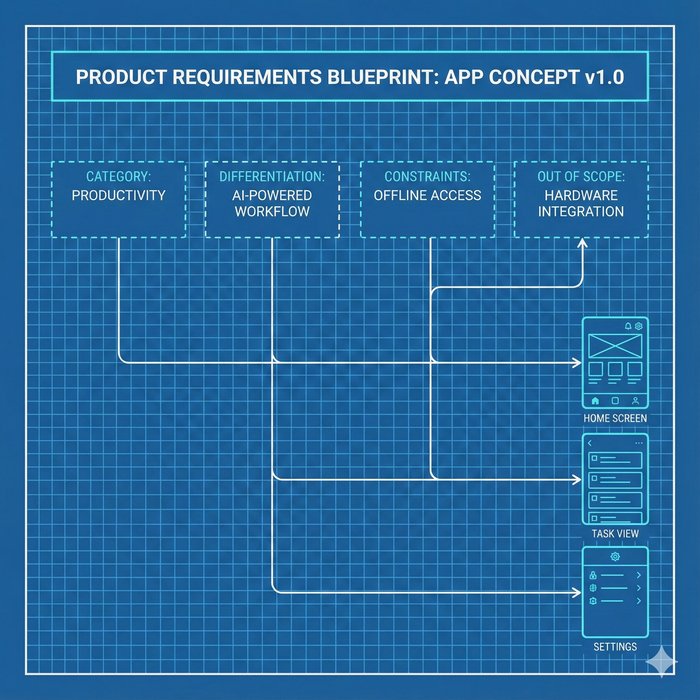
- The full feature structure of the app becomes visible at once
- Each feature can be placed within a specific user flow
- The incoming request can be identified as belonging to a particular stage
- It becomes clear whether the request is a simple tweak or a structural change
- The impact of the change on other features can be anticipated in advance
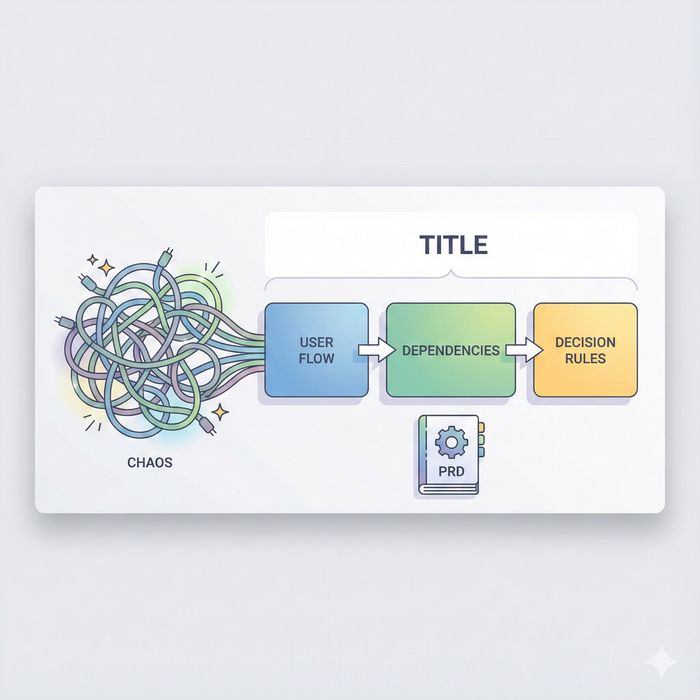
The PRD is not just a document that stores information. It is a reference point that enables interpretation, classification, and judgment of change requests.
Comparison: What happens when changes pile up without a PRD
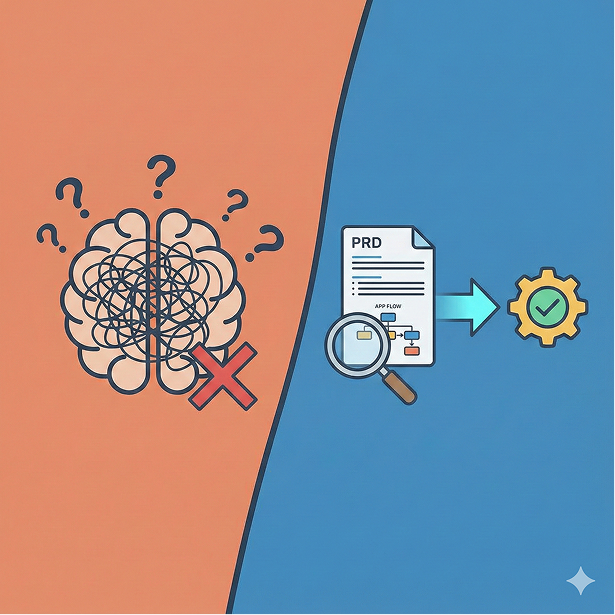
When changes are made repeatedly without a PRD, work becomes increasingly reactive. Each request is handled in isolation—patched, added, or worked around on the spot. At first, problems seem resolved.
But eventually, teams reach a point where they can no longer clearly explain why things work the way they do. Questions like “Why is this built this way?” no longer have clear answers.
When changes are made with the PRD as the reference, every request is interpreted within the overall structure. Some requests are implemented immediately, others are deferred, and some are recognized as signals that the original design needs to be revisited.
Conclusion: The PRD is both a “summary context” and a manual in the maintenance phase
The PRD is not a document used only at the initial implementation stage. Its role becomes even clearer during ongoing maintenance and iteration.
It functions as a summary context that allows the entire app to be quickly re-understood, a manual that helps even newcomers grasp the structure, and a guideline that clarifies what should be changed and what should not.
That is why modification work becomes stable and sustainable only when it is grounded in the PRD.
Summary
As time passes, an app becomes too complex for anyone to fully remember. Maintenance cannot rely on memory alone.
The PRD serves as a concise reconstruction of the app’s overall flow and as a standard document for deciding changes and feature additions. With this standard in place, changes become manageable rather than chaotic.