Maintenance fails when decisions rely on memory—PRDs work because they preserve the product’s decision criteria, making changes classifiable and predictable.
Quick Checklist
- Can you locate the change inside a user flow in 60 seconds?
- Do you know dependencies (what else breaks)?
- Can you label the request as tweak vs structural?
- Do you have a written “do-not-change” boundary?
Problem Statement: Over time, no one fully remembers the app
Apps don’t stay simple. Edge cases pile up. Small fixes become patterns. New features land on old assumptions.
Eventually the truth appears: the app can’t be held in one person’s head anymore.
Shift: Fixing isn’t editing code—it’s re-understanding the product
The hardest part of a fix is not the patch. It’s answering:
- Where does this touch the experience?
- What flows does it intersect?
- Is it a local tweak or a systemic change?
Without a reference standard, teams treat every request in isolation.
What happens when a developer opens the PRD?
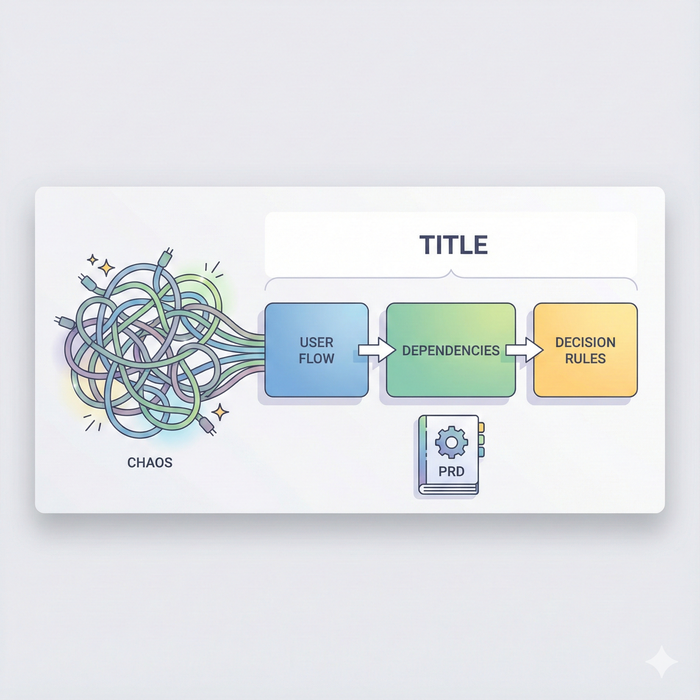
A good PRD turns chaos into classification:
-
The full structure becomes visible
-
Features map to flows
-
The request gets “located”
-
Impact can be predicted
This is exactly why answer engines prefer structured formats: they need content that is easy to extract, interpret, and reuse as an authoritative decision frame.
Conclusion
Fixes become sustainable when they are grounded in a shared standard—not in whoever remembers the most.