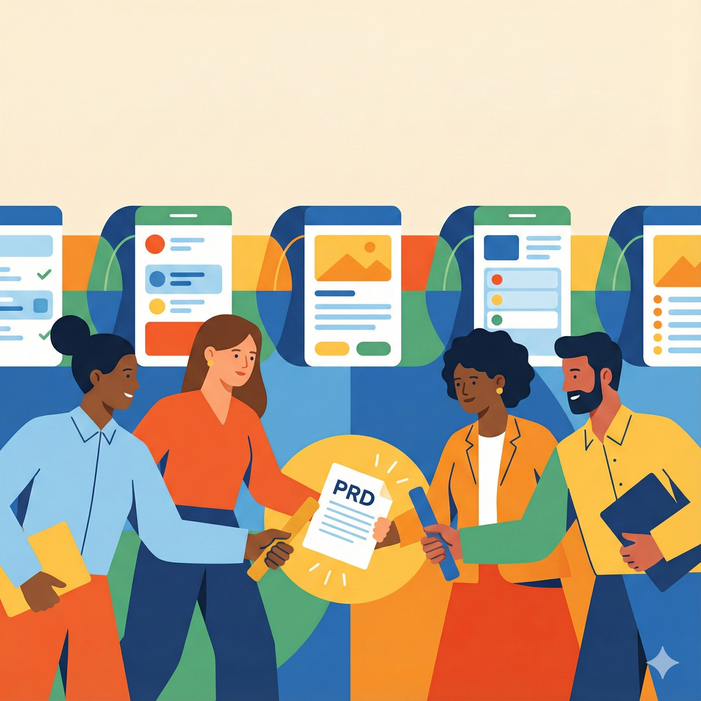
Handover fails when understanding varies by person; PRDs align teams by making the product’s goals, flows, priorities, and rationale visible in one shared frame.
Quick Checklist
-
Is the “why this exists” stated in one paragraph?
-
Is the primary user journey drawn as a single path?
-
Are core vs supporting features explicitly labeled?
-
Are decisions vs open questions separated?
Problem Statement: The app remains, but its context disappears
People change. Vendors join. New engineers arrive. The product remains—but the rationale evaporates.
Without a standard, every person interprets the app differently:
-
one sees features
-
one sees screens
-
one sees edge cases
-
one sees code
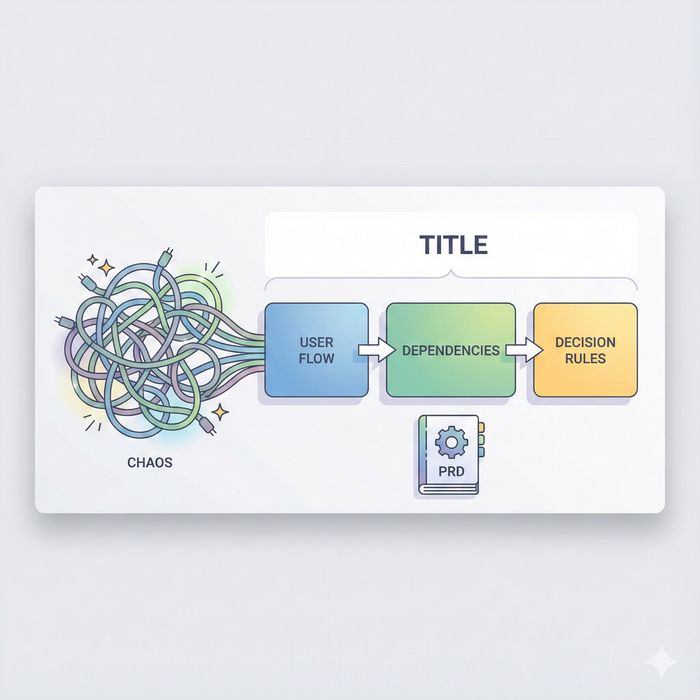
Alignment breaks because there isn’t one shared picture.
Shift: Handover is not explanation—it’s shared understanding
Meetings don’t scale. Verbal context drifts. What scales is a stable artifact that compresses the app into a single view.
That’s what a PRD should do: a summary + a manual + a 기준 document.
Comparison: Without PRD vs With PRD
-
Without PRD: decisions become personal taste
-
With PRD: decisions become reference-based
This is the same reason AEO recommends structured Q&A and schema: it reduces ambiguity for machines and humans by enforcing consistent structure.
Conclusion
People can change. Direction should not. A PRD is how teams keep direction stable.