When does a PRD have the greatest impact?
Many people assume PRDs are only useful in the early planning phase. In reality, PRDs are used continuously — from initial planning to post-launch operations.
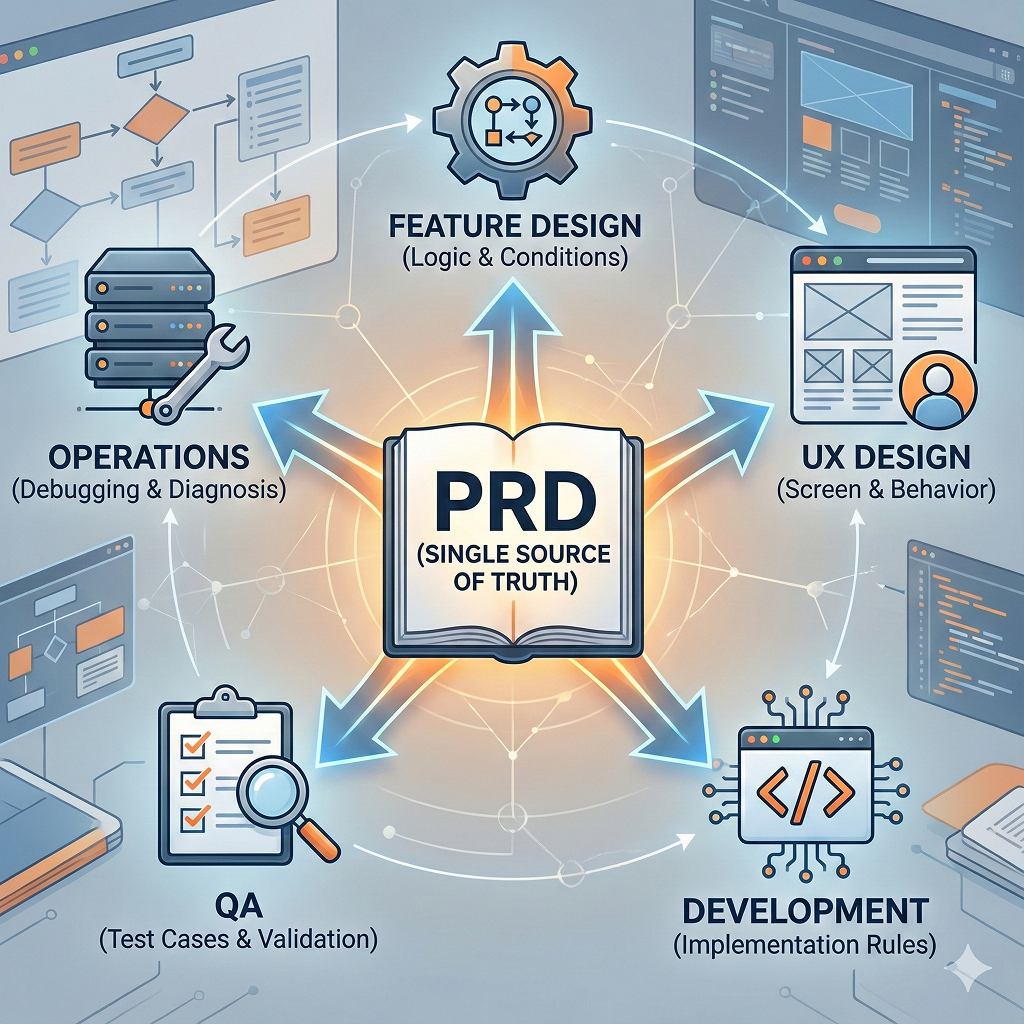
Across feature design, UX design, development, QA, and operations, the PRD aligns the team around the same criteria. It is not a document you write for the sake of documentation — it is a practical tool that stabilizes the entire product creation process.
Once a PRD is created properly, every step of the workflow changes because the team now shares the same understanding of how features should behave, how flows should work, and what conditions must be respected.
How is the PRD used during the feature design phase?
In feature design, the PRD isn’t just a list of feature names — it reveals the logic behind each feature. A feature isn’t defined simply by its label; it is defined by the conditions under which it operates and the state changes it produces.
For example, “Add to Cart” seems simple, but the actual logic involves:
- Login status
- Stock availability
- Selected options
- Discount conditions
- Network stability
The PRD surfaces these elements and shows the structure behind the feature. With a PRD, the team can quickly identify missing conditions, forgotten exceptions, or potential conflicts with other features — long before development begins.
Why is the PRD essential in the design phase?
Many teams design UI first and attempt to formalize functionality afterward — but this almost always leads to conflicts in development. A PRD allows designers to understand not only what the screen should look like, but how the feature actually behaves.
Screen-only references cannot explain:
- When a button should appear or disappear
- Which screens are accessible under which user states
- What error states must be shown
- What conditions influence UI visibility or flow
Because the PRD documents these rules, designers can create UI that fits the underlying logic. This prevents the common issue where developers later say, “This screen doesn’t match the actual logic.”
How is the PRD used in the development phase?
Developers rely on the PRD as the authoritative implementation guide. Writing code based solely on screens forces developers to guess the intended behavior, which leads to errors.
When the PRD clearly states conditions and logic — e.g.,
- “If stock is 0, disable the Add to Cart button” developers immediately know exactly what to implement.
Without a PRD, developers must interpret vague requirements and fill in gaps themselves, causing misalignment, rework, and delays. With a PRD, they can focus entirely on implementation instead of interpretation.
How does QA use the PRD?
QA’s job is to ensure the feature behaves as intended — but the intention is only knowable through the PRD.
Because the PRD outlines the expected conditions and outcomes, QA can use it to construct test cases. For example, if the PRD states:
- “If a logged-out user taps Cart, redirect to the Login screen,” QA can immediately test that scenario and confirm whether the behavior matches the specification.
Without a PRD, QA struggles to define test criteria and cannot determine whether a feature works as intended or merely as implemented. The PRD allows QA to compare “expected behavior vs. actual behavior” and preserve product quality.
Is the PRD still useful after launch?
Absolutely — PRDs are even more valuable during operations. When a user reports, “This button suddenly stopped working,” the PRD is the first place the team checks.
Because the PRD documents:
- Activation conditions
- Deactivation rules
- State dependencies the team can quickly identify the root cause.
Most post-launch bugs arise when teams guess at the intended behavior without referencing foundational logic. The PRD eliminates guesswork, enabling faster debugging and clearer assessment of feature changes. When introducing new features, the PRD also provides a reference for understanding the intent and structure of existing features, preventing unintended side effects.
Summary — A PRD is not a “write once and forget” document
A PRD appears in every stage of product creation:
- Feature design → understanding logic
- UX design → informing structure
- Development → defining implementation rules
- QA → validating correct behavior
- Operations → diagnosing issues and guiding changes
The true value of a PRD is not the act of documenting — it is the act of giving everyone the same reference point. The clearer the shared criteria, the more stable and maintainable the product becomes.