Why does the PRD keep changing during development?
A PRD can never be perfect from the beginning. Once the team begins implementing features, differences between the initial concept and real-world behavior naturally appear. User needs shift, feature conflicts emerge, and UX flows evolve.
As a result, the PRD must be continuously updated. This doesn’t mean the document was wrong — it simply reflects the natural process of transforming ideas into a real product.
This is why teams keep the PRD open while building an app or web service: the PRD is not just the starting point but the evolving reference that stays aligned with the work being done.
What happens if changes are not documented?
If PRD updates are not recorded, the team eventually relies on memory — and as the product grows, context disappears. Without proper change logs, the same issues keep repeating:
- Decisions get re-discussed or duplicated.
- Designers and developers interpret the same feature differently, causing conflicts.
- When issues occur in production, diagnosing the root cause takes far too long.
By documenting changes, the team retains the reasoning behind past decisions and maintains consistent understanding across all stages of development.
What should be recorded when updating a PRD?
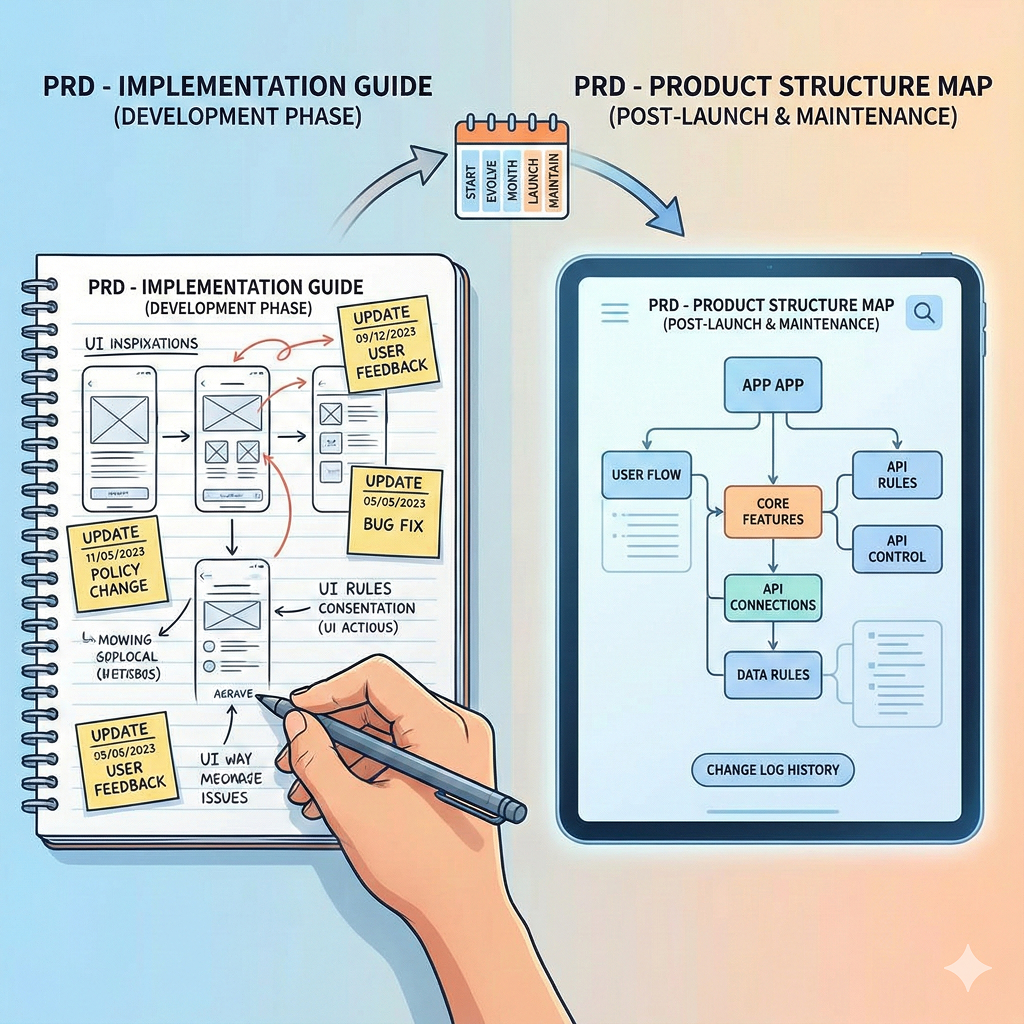
A PRD update is not merely modifying the text — it must capture the reason and logic behind the change. Our team always records three key elements: a. The updated conditions, rules, or flow of the feature b. The reason for the change (user feedback, bugs, policy changes, technical constraints, etc.) c. The impact of the change on other features
Documenting these ensures the team always understands why the feature is shaped the way it is, making future improvements and maintenance significantly easier.
How do PRD update logs impact design and development?
When the PRD is kept up to date, designers and developers always work from the same source of truth.
If the visibility condition of a button changes, designers can immediately adjust UI flows, and developers can update the logic accordingly.
Because the PRD connects screens, flows, rules, and logic, change logs ensure consistency across the entire product. Keeping the PRD open while working helps maintain alignment with the intended behavior of the feature.
What role does the PRD play after the app or web product is complete?
In the early stage, the PRD is a detailed implementation guide. But once the product is complete, the PRD evolves into something entirely different: a concise map of the product structure.
As time passes, features blend into screens and code, and no team can remember every detail. The PRD becomes: a. A reference that shows how features connect b. A tool for onboarding new team members c. A guide for deciding how to modify or expand existing features
In other words, the PRD shifts from a construction blueprint to a “product handbook.” This transformation is the reason a PRD must be maintained continuously, even after launch.
Why does the PRD become even more important during maintenance?
In maintenance, the most important question is: “What was the original intent of this feature?”
When the PRD includes change history, the team can quickly determine:
- The feature’s original purpose
- The conditions it was designed to follow
- Whether the current behavior is correct or unintended
This makes troubleshooting logical and efficient. A PRD without change logs is simply old documentation, but a PRD with change logs becomes a living guide that supports long-term product health.
Conclusion — A PRD evolves from a detailed specification into a structural overview
A PRD begins as a detailed implementation document, but after launch it becomes a high-level map that summarizes the entire product. Continuous updates are natural — and when managed properly, they make the PRD increasingly valuable over time.
Ultimately, a PRD is not a one-time document. It grows with the product, preserves its intent, and guides the team through every stage of development.