Are the Requirements Definition Document and the PRD basically the same thing?
Many teams assume, “Both documents describe the product, so they must be similar.” But in real development work, you quickly realize that these two documents have entirely different purposes.
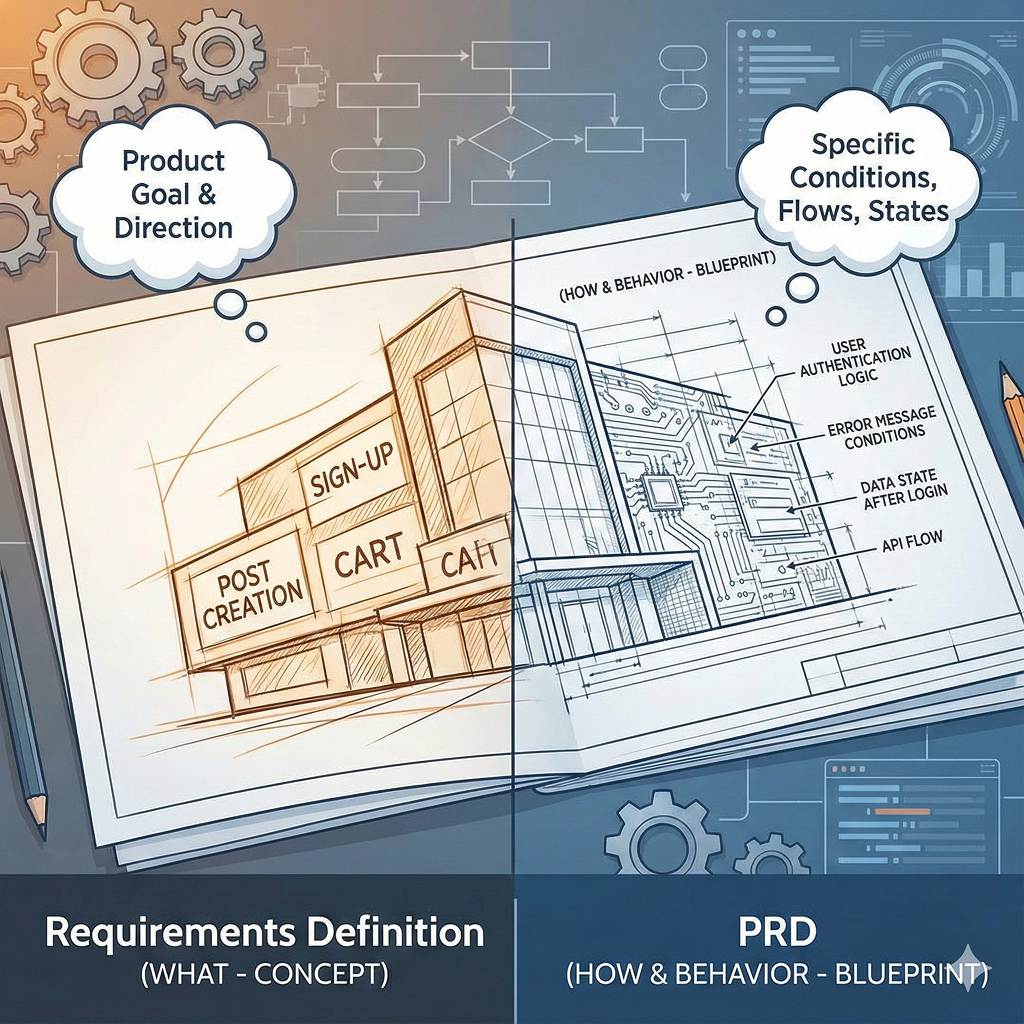
A Requirements Definition Document declares what features the product needs. A PRD (Product Requirements Document) explains how those features must behave under specific conditions.
They may look like one document on the surface, but their roles and levels of depth are so different that they cannot be compared. In fact, most misunderstandings between planning, design, and development happen because these two documents are not distinguished properly.
So what exactly does a Requirements Definition Document describe?
A requirements definition document outlines the product’s goals and high-level features. It declares what problem the product solves, what core features should exist, and the general flow of the service.
It is a top-level document focused on “what” the product is. Examples include:
- “A sign-up feature is required”
- “A post creation feature is needed”
- “A cart feature must be included”
This document is helpful for defining project direction, but it does not describe how the feature should actually work. So if development starts based only on the requirements definition, each teammate interprets it differently, and everyone ends up imagining different behavior for the same feature.
Then what additional information does a PRD provide?
A PRD explains exactly how a feature must behave under every condition and flow.
For example, for a “login feature,” a PRD answers questions like:
- What conditions must be checked when logging in?
- After how many failed attempts should an error message appear?
- Which screen should the user be routed to when authentication fails?
- What user state must be created after login?
- What constraints are required so this state doesn’t conflict with other features?
A PRD provides clear, implementation-ready rules — the level of detail a developer needs to write actual code. Without a PRD, you may know the name of the feature, but not how it should behave in real usage. Confusion naturally grows as the project progresses.
Why does development fall apart when you start with only a requirements definition?
Because a requirements definition contains only feature names and intentions, each person inevitably interprets it differently.
Planners, designers, and developers all view the same sentence through different professional lenses:
- A planner sees problem-solving logic
- A designer imagines screen layout and flow
- A developer thinks about data, states, and API logic
This is why the simple phrase “We need a sign-up feature” produces completely different mental images for each role. To the planner, it means choosing authentication methods. To the designer, it means designing UI elements. To the developer, it means implementing authentication logic, exception handling, and API behavior.
The result? Even small features become inconsistent or incorrectly implemented. This problem almost always occurs when only a requirements definition exists.
So how should these two documents work together?
The Requirements Definition and the PRD are not substitutes — they have a hierarchical relationship.
- The Requirements Definition defines what to build.
- The PRD defines how to build it and how it must behave.
The requirements document gives direction, and the PRD transforms that direction into executable specifications. In architectural terms, the requirements definition is the building’s concept; the PRD is the engineering blueprint. If either is missing, the development process becomes unstable and unpredictable.
So what does the team actually need?
The hardest part for any team is not the writing itself — it is getting everyone to imagine the same thing at the same time. Planners describe flows, designers create screens, and developers build logic — but if their mental images differ even slightly, the final product will diverge.
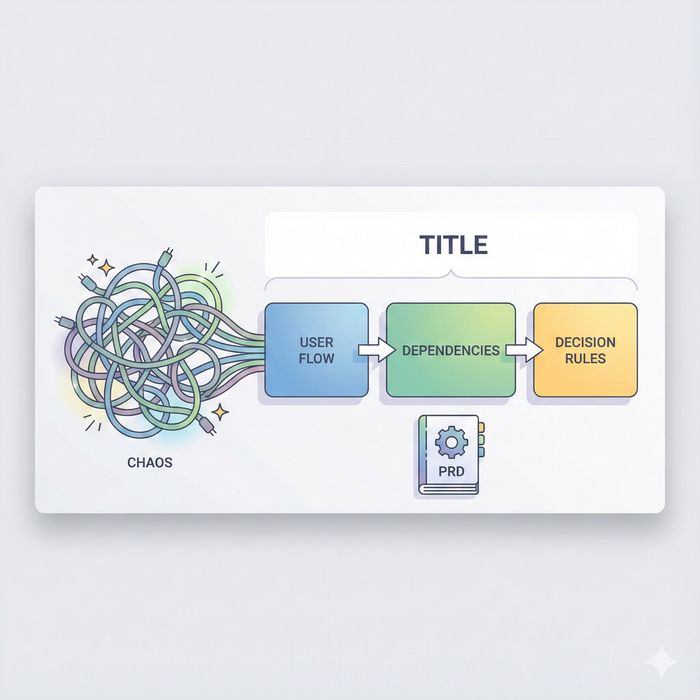
The true value of a PRD lies here. A PRD unifies the team by standardizing every element that defines feature behavior:
- Conditions
- Flows
- Exceptions
- States
- Expected outcomes
With a PRD, development speeds up, rework decreases, and the dreaded phrase “That’s not what I meant.” almost disappears from the project.
Conclusion — They look similar, but their purposes are entirely different
The Requirements Definition declares the product’s direction. The PRD provides the detailed criteria needed to convert that direction into real, functioning features.
Confusing the two derails development from the start. Using each document for its correct purpose makes development far more stable, predictable, and aligned.
The key to building a good product isn’t writing more documents — it’s using the right document for the right purpose.