Why are so many indie developers trying vibe coding without a PRD?
As vibe coding becomes popular, many developers choose the strategy of “let’s just build it and fix it later.” They ask the AI to make screens, describe functions on the fly, and supply flows when needed. This approach feels incredibly appealing because it starts fast and produces visible results instantly.
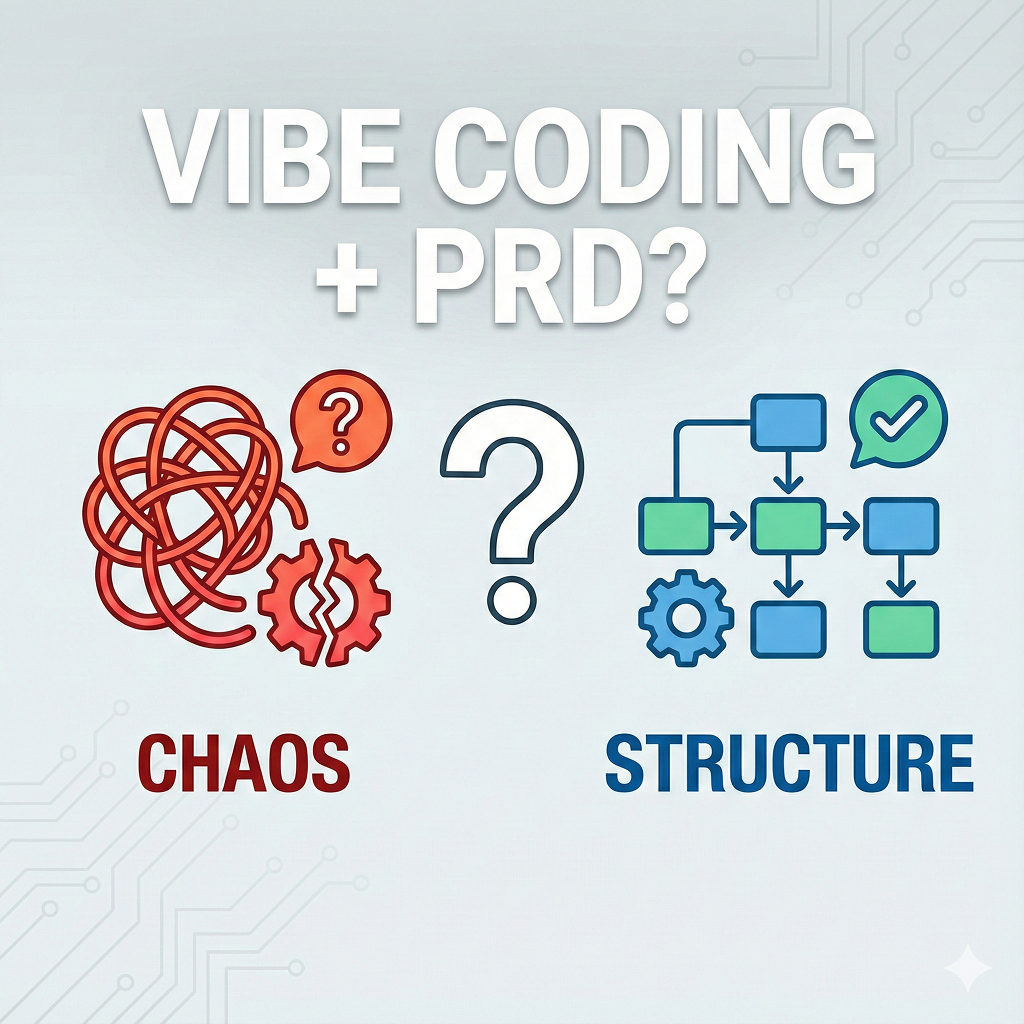
The issue is that the faster they begin, the more completely they forget the need for a PRD. No defined screens, no organized features, no user flow—everything becomes pure “intuition-based development.” Vibe coding was meant to help you move fast, not to justify skipping structure. But many people misunderstand this point.
What’s the first thing that breaks when you build an app without a PRD?
The very first thing to collapse is the screen flow. Developers often begin like this:
- “Create a screen where users can upload posts.”
- “Add a comment feature too.”
- “Notifications would be nice, right?”
- “Oh wait, we don’t have a profile screen yet.”
The AI will generate whatever you ask for—but no one ever explained how these screens are supposed to connect. So the flow becomes jumbled, navigation grows vague, and eventually developers keep asking themselves: “What structure was I originally trying to build?”
Why does the AI keep making strange suggestions when there’s no PRD?
AI generates based on the context provided. The problem is simple: there is no context. If you request features one by one without a PRD, the AI can’t see the whole structure and starts stitching fragments together.
This leads to outcomes like:
- Screens that don’t match the intended style
- Suggestions for features you never needed
- Re-creating features you already mentioned in a different form
- Adding conditions that conflict with the existing flow
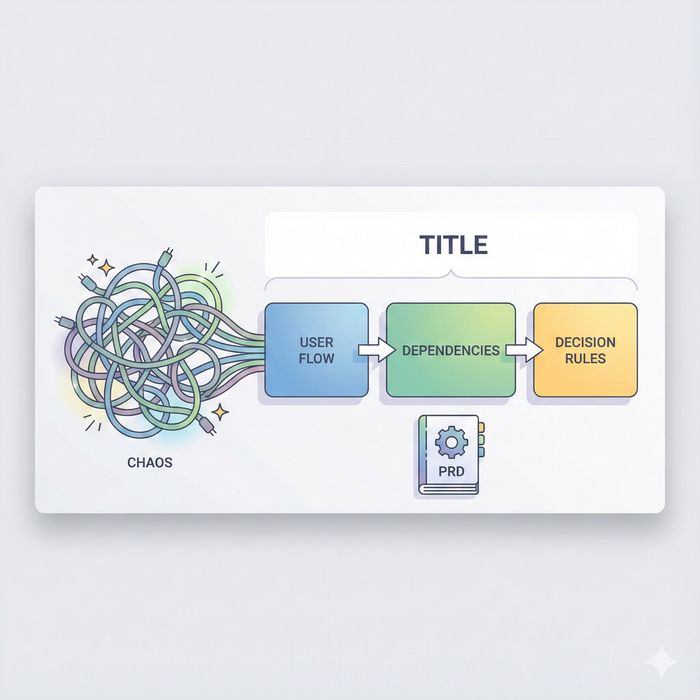
This isn’t because the AI is incapable — it’s because it was never given a baseline (the PRD). When the baseline is unclear, the AI invents its own. And the result, naturally, becomes chaotic.
Why do features start conflicting with one another the more you add?
The trap of vibe coding is that “adding one more feature” feels incredibly easy. But features are interconnected structures.
If you input them randomly without a PRD, you start seeing issues like:
- Conditions for feature A conflicting with feature B
- A’s exception logic changing because of C
- Data structure having to be rewritten for B
- The more features you add, the more the overall flow collapses
Features are not individual dots—they are connected lines. If the shape of those lines is not documented, the entire logic of the app collapses.
So what is the root cause of all these problems?
It’s simple: there is no PRD.
A PRD does not restrict features, it provides the central spine that organizes them:
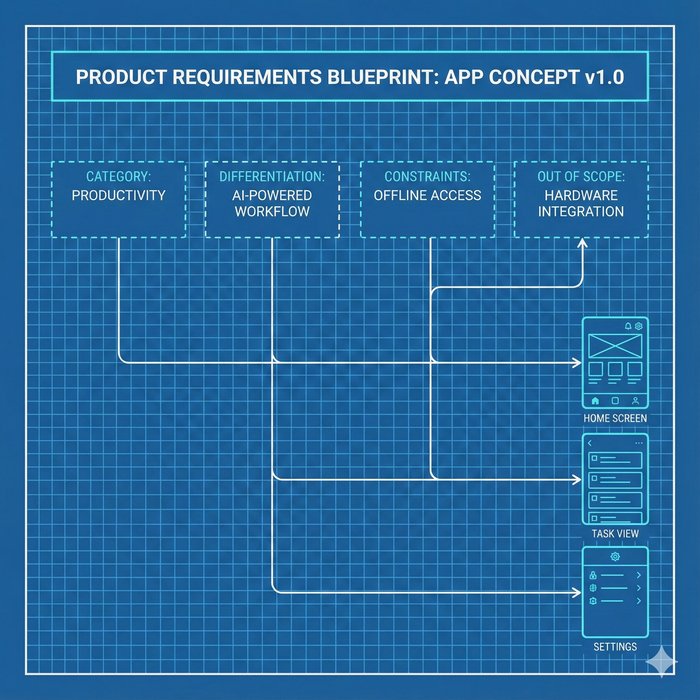
- What screens are needed
- How screens connect
- How data moves
- What exceptions exist
- What conditions define each feature
Without these, no matter how fast AI or no-code tools become, the result will be unstable, and you’ll spend far more time later fixing the structure. Thinking PRD is unnecessary in vibe coding is a misunderstanding. In fact, the faster you build, the more you need a central guiding document.
So what’s the final takeaway?
Building quickly with vibe coding is perfectly fine— but rapid development only succeeds when you have a clear standard. That standard is the PRD.
Without a PRD, screens and features multiply but direction disappears, AI generates outputs without context, structure collapses, and maintenance becomes a nightmare.
A PRD is not a document that slows you down— it’s the safety mechanism that becomes indispensable when speed increases.