Why is it impossible to build a house, car, or piece of furniture without a blueprint?
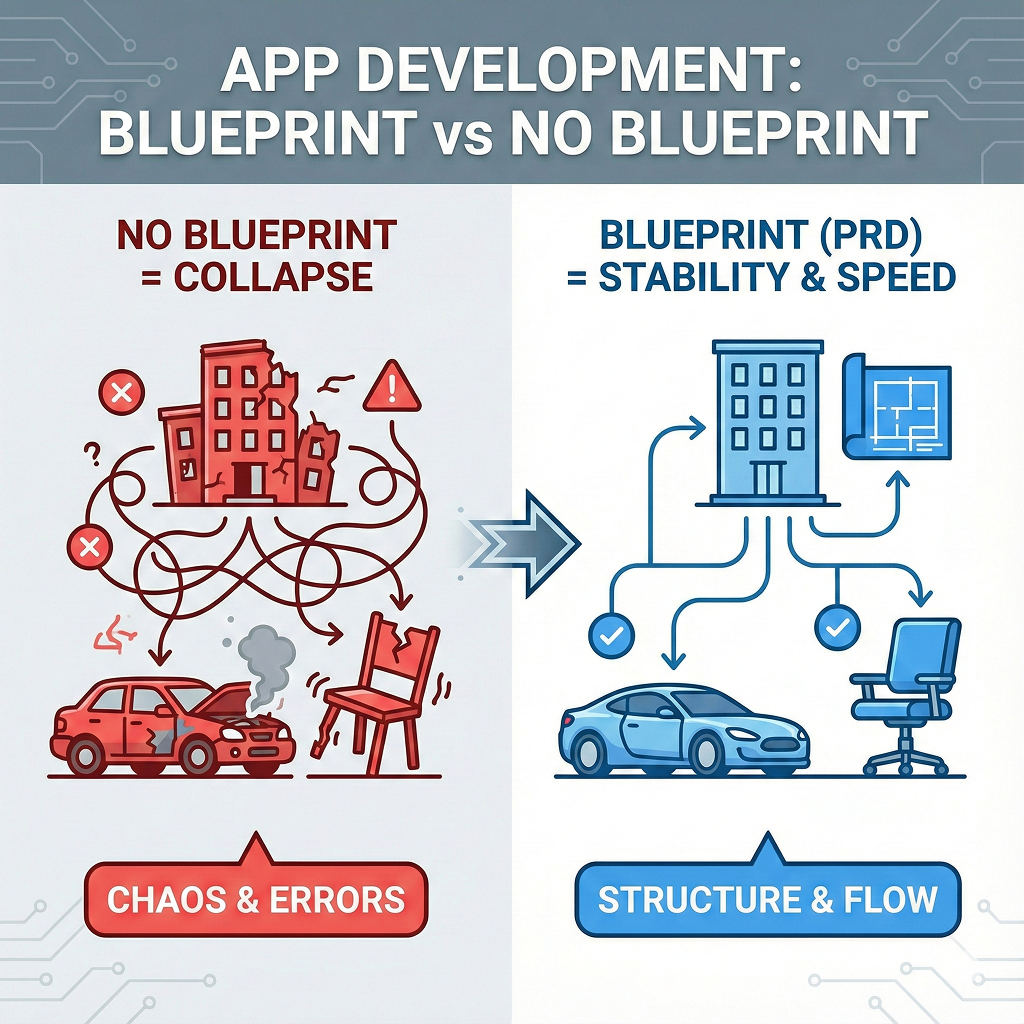
If you build a house without a blueprint, no one knows where the pillars should stand, how the load will be distributed, or where electrical and plumbing lines should run. The builder must continually ask, “What should I do here?” and rely on instinct for each decision. A single instinctive judgment shakes the entire structure, and small errors eventually grow into major defects.
Cars are the same. Engines, wiring, and frames move according to designs calibrated down to the millimeter. Without a blueprint, each part follows a different standard, resulting in mismatched components that don’t operate or completely collapse in safety.
Furniture also requires assembly order, dimensions, and weight structure. Without them, you get wobbly desks, drawers that don’t fit, or pieces that cannot be assembled at all.
Without design, the builder loses clarity on what to do, how to do it, and in what order — everything becomes tangled. This is an absolute principle of building any structure. Apps are no exception.
Then why do people think they can start building an app without a design?
In physical structures like houses and cars, the absence of design causes immediately visible problems, so nobody ignores it.
But apps are invisible digital structures, and many people mistakenly believe, “I can just start building and fix it later.”
Just as cracks instantly appear in a building without blueprints, an app without design collapses after just a few screens. Screen connections, conditional flows, and data pathways are all invisible skeleton components — and if you don’t define them, everything seems fine at first but breaks as soon as the app grows even slightly.
These are simply “invisible cracks” in the digital world. Like building a house without blueprints, creating an app without design forces the builder to rely on instinct for every decision, and the structure twists more and more over time.
What kind of confusion do builders (developers, creators, or AI) face when creating an app without design?
Imagine a construction site where a house is built with no architectural plans:
- The carpenter wonders, “Is it okay to put this wall here?”
- The electrician asks, “Which direction should this line run?”
- The plumber worries, “What if the water flow gets blocked?”
Everyone tries their best, but without an overall structure, their decisions collide.
Apps experience the exact same confusion.
- The person creating screens doesn’t know what the next screen should be
- The person implementing features doesn’t know where conditions should be processed
- AI lacks the full structure, so it suggests illogical flows
- Data structures are created per feature and become incompatible with one another
Just as mismatched parts on a construction site make assembly impossible, an app without design results in conflicting features and misaligned flows. The issue is not the builder’s skill — it is the absence of design.
Why does design make the development process faster?
A carpenter building a house never asks, “Where should this pillar go?” because the blueprint already answers that. A car engineer doesn’t wonder how to route the wiring — the diagram gives the standard.
Builders do not waste time making decisions; they simply execute.
Apps work the same way. With a design (PRD):
- Screen structure is clear
- Flow is documented
- Conditions are already defined
- Exception handling is predetermined
- Data pathways are visible
This eliminates time wasted on “What should I do here?” Design does not slow speed — it guarantees speed.
Then what role does a PRD play in app design?
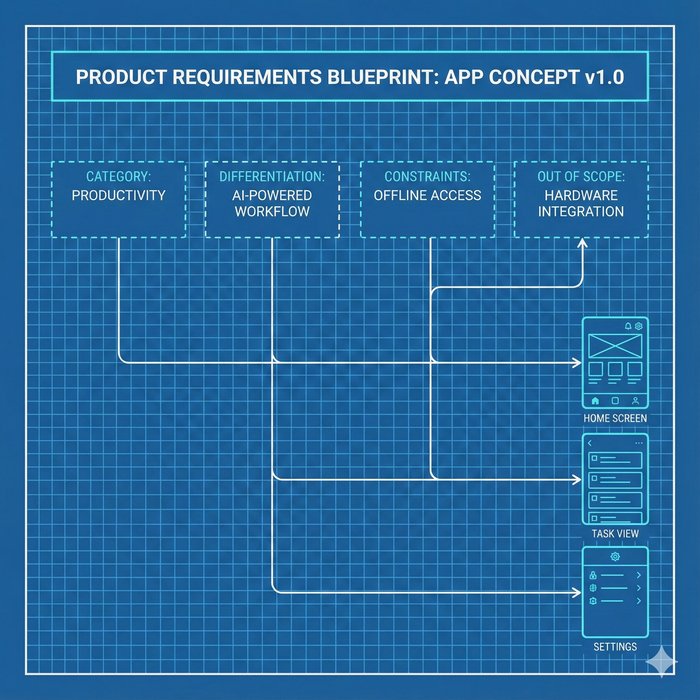
A PRD is the blueprint and structural foundation of an app.
-
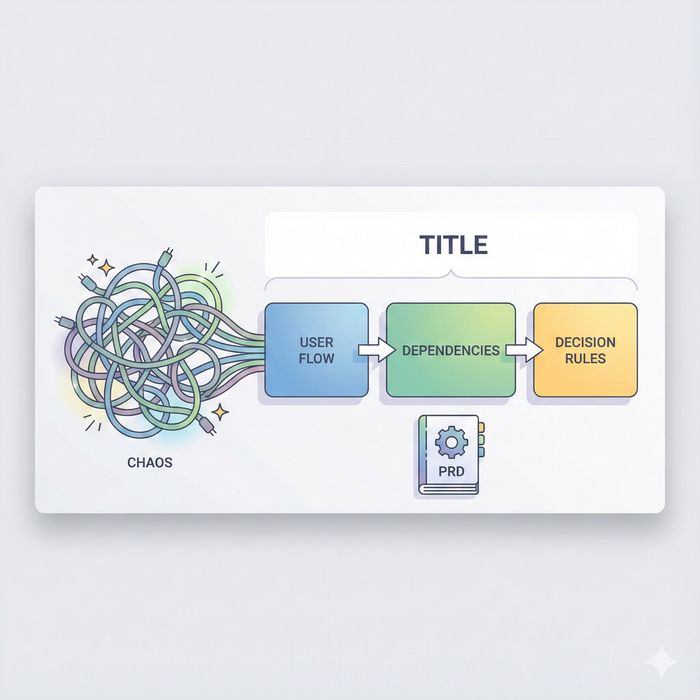
Just as architectural drawings define load distribution, room layout, and electrical wiring, → A PRD defines feature structure, screen flow, state changes, conditions, exceptions, and data requirements.
-
Just as car diagrams specify engine placement, frame structure, and part alignment, → A PRD clarifies how each app feature operates within its context.
A building without blueprints cracks over time, and an app without a PRD becomes structurally weak the moment features expand.
A PRD is not merely a “development document.” It is the architectural blueprint that holds the entire app structure together.
Conclusion: Why does an app without design eventually collapse?
A building without design cracks under small impact and becomes unsafe over time. A car built without a diagram may look complete but will never be safe on the road. Furniture assembled without instructions may stand for a moment but will wobble and break soon after.
Apps are the same.
As features grow, user flows become complex, conditions multiply, and data increases — an app without design develops structural fractures from the inside.
Maintenance becomes impossible, errors repeat, and eventually the builder must start over from scratch.
A PRD is the only blueprint that prevents this collapse. To build fast, you don’t remove design — you need an even more precise design (PRD).
An app is a structure. And every structure requires a blueprint.