What does it mean to repeatedly check context?
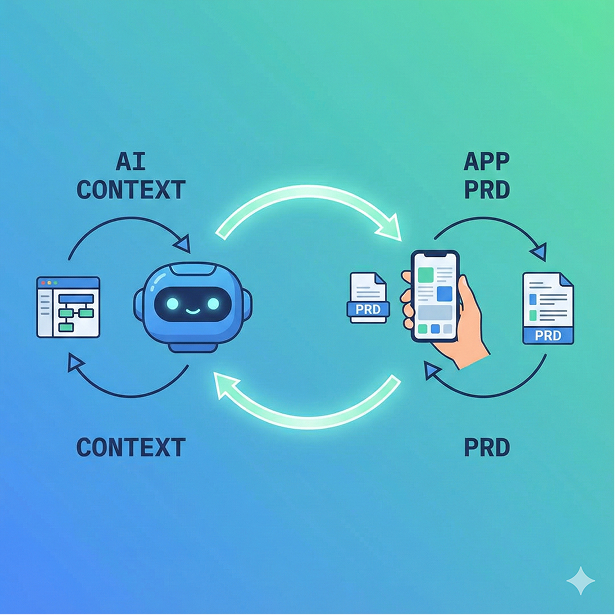
If you look at recent AI agent architectures, there is one clear pattern: they continuously recheck context while working.
Here, context does not mean a single prompt. It includes goals, constraints, past decisions, and the current state—everything that defines the criteria for judgment.
Agents repeatedly refer back to this context to ask, “Is this still the right decision right now?” Technically, this may seem like a new approach. In reality, it closely mirrors how humans already work when they do things well.
Decision Criteria: Why isn’t a single instruction or memory enough?
Skills have become a major focus in the agent space. Abilities like search, summarization, and code generation are clearly important.
But as skills increase, another problem emerges. Without a clear standard for when to use which skill, results become unstable.
The same is true for human work. Even if someone has enough ability to implement features, decisions start to drift if priorities and direction are not clearly defined. What matters most in this situation is having a reference point that can be checked continuously.
Comparison: Work driven by memory vs. work guided by a PRD
Work that relies on memory alone feels fast at first. But it doesn’t take long before questions arise: “Was this really the original intent?”
Working with a PRD is fundamentally different. Keeping a PRD beside you while building an app means continuously checking whether the feature you’re implementing aligns with the overall flow.
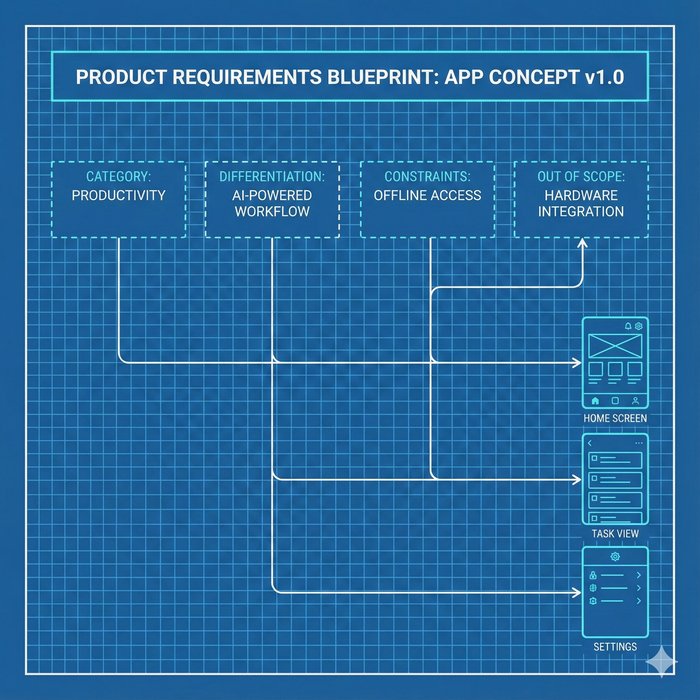
Which screen comes first, how users move through the app, whether a feature is core or secondary—these decisions are already organized in the PRD. When that context exists, decisions come not from individual intuition, but from a shared workflow.
Outcome: A PRD is the ‘external context’ humans need
Just as modern agents don’t try to remember everything internally and instead repeatedly load structured external context, humans also cannot hold all judgment criteria in their heads.
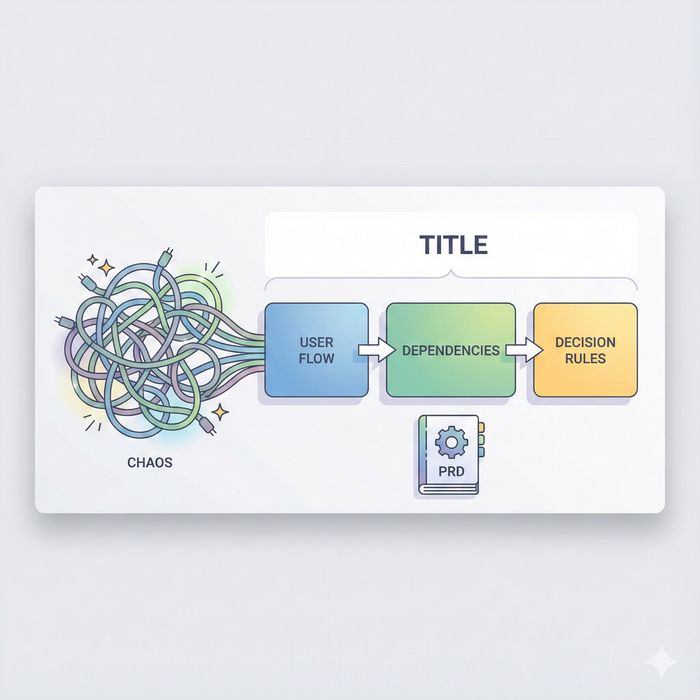
That is exactly what a PRD provides. It is not just a list of features—it is an organized context that explains the app’s overall structure, flow, and the reasoning behind decisions. Revisiting the PRD during development, or when adding or modifying features, is an act of checking whether the current choice still aligns with the overall system.
Summary: What matters more than skills is a reference that can be checked repeatedly
While skills receive a lot of attention in AI agents, stable outcomes come from a structure that repeatedly checks context. The same logic applies to app development.
A PRD is not a document you read once and forget—it is a workflow and a system that is continuously referenced throughout the work. Decisions based on memory tend to drift. Context that is structured externally preserves direction.