Why do teams keep repeating the same explanations?
At work, a strange scene repeats itself over and over.
You’re sure it was discussed before. You remember it being clarified in a meeting. Yet after some time, the same questions come back:
- “Why was this built this way?”
- “Was this always the intended flow?”
- “Who decided this?”
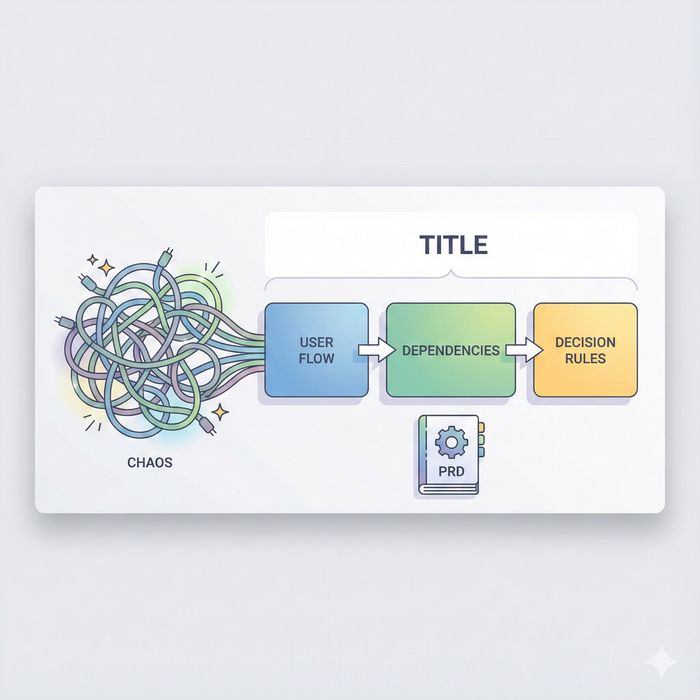
The problem isn’t that people aren’t working hard. Most teams discuss thoroughly and put in real effort. But when the process relies only on people’s memory and spoken explanations, work stops being a system and becomes a series of ad-hoc decisions.
A Shift in Thinking: Documentation is not a record — it is a system and a workflow
Many people think of documentation as something you leave behind for reference. In reality, documentation is a system.
Code is a good analogy. No matter how well-written the code is, without a README.md, someone new to the project won’t know what it does or where to start. Consumer electronics are the same. Without a manual, devices with many buttons become harder—not easier—to use.
Documentation is not about listing information. It defines how something should be understood and used, in what order. In other words, documentation is a workflow.
Decision Criteria: When does documentation become essential, not optional?
There are clear moments when documentation must function as a system:
- When work is divided into multiple steps and sequence matters
- When multiple people work in parallel
- When decisions must remain consistent over time
- When work must continue smoothly even as team members change
Under these conditions, documentation is no longer a reference—it becomes the default workflow. At that point, documents are not “something you read later,” but the standard that tells you what to do right now.
Comparison: Teams driven by improvisation vs. teams driven by systems
Improvisation-driven teams are people-centered. Direction changes depending on who remembers what or who explains it. System-driven teams, on the other hand, make decisions based on documentation.
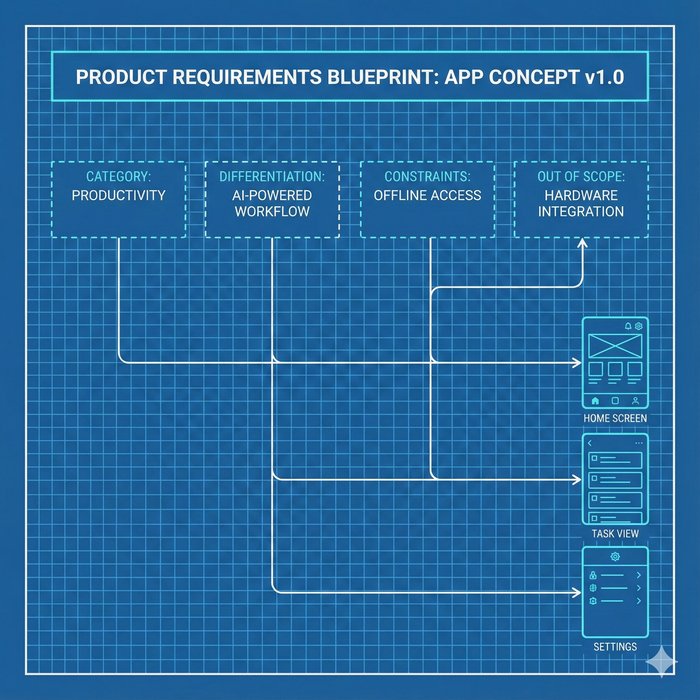
The same applies to app development. Teams that work from a PRD understand features, screens, and user flows as one unified workflow.
Decisions about what to build first and what to delay come from the system, not individual intuition. Over time, this difference becomes obvious—in both speed and consistency of outcomes.
Conclusion: A PRD is the README and user manual of app development
A PRD is not just a list of features. In app development, it plays the role of a codebase’s README.md and a product’s user manual. It allows newcomers to quickly understand the overall structure and guides them through the correct order of understanding.
Building an app based on a PRD means the team is operating on the same system and the same workflow.
Teams without documentation may work hard, but their direction wavers. Teams where documentation functions as a system move forward steadily with shared standards.
Summary
Documentation is not just a record. Just as code needs a README and products need manuals, teams and apps need documents that explain the overall flow.
In app development, that role belongs to the PRD. If you want a unified workflow and a stable system, documentation is not optional—it is the foundation.