Why is vibe coding so popular? Because it lets you build and iterate fast.
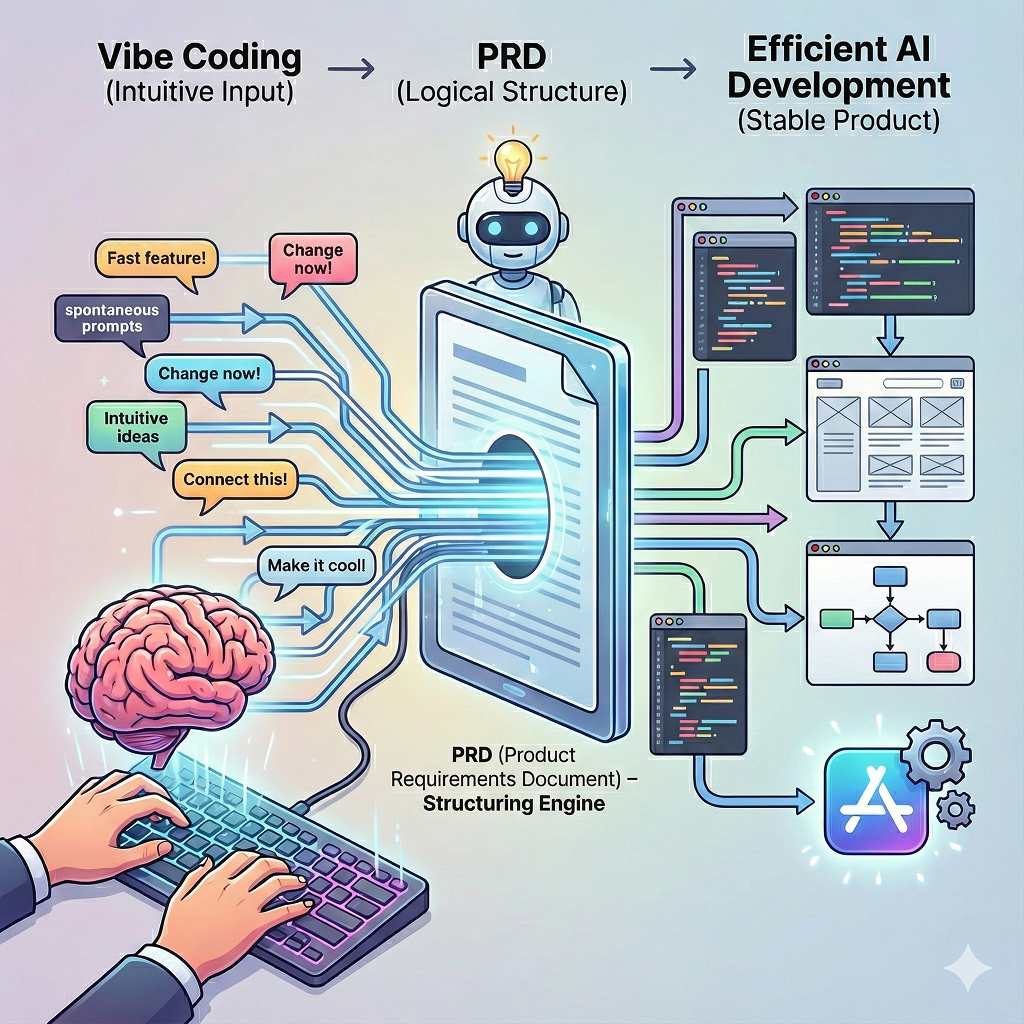
Vibe Coding allows teams to turn spontaneous ideas into working screens immediately, see results right away, and refine them quickly. You can start building without a perfect plan, and the “adjust as you go” nature is especially powerful in the idea or MVP stage where speed matters most.
But as speed increases, complexity also increases. Features begin to interact, screens multiply, and logic becomes harder to track. At some point, the method that felt fast starts slowing the team down due to scattered flows and unclear logic.
Why do users type their prompts like a stream of consciousness?
Most users are not developers. When they describe the app they want, they don’t write in structure. They usually:
- List features in random order
- Mix important and minor requirements together
- Combine UX, logic, and policy in a single unorganized paragraph
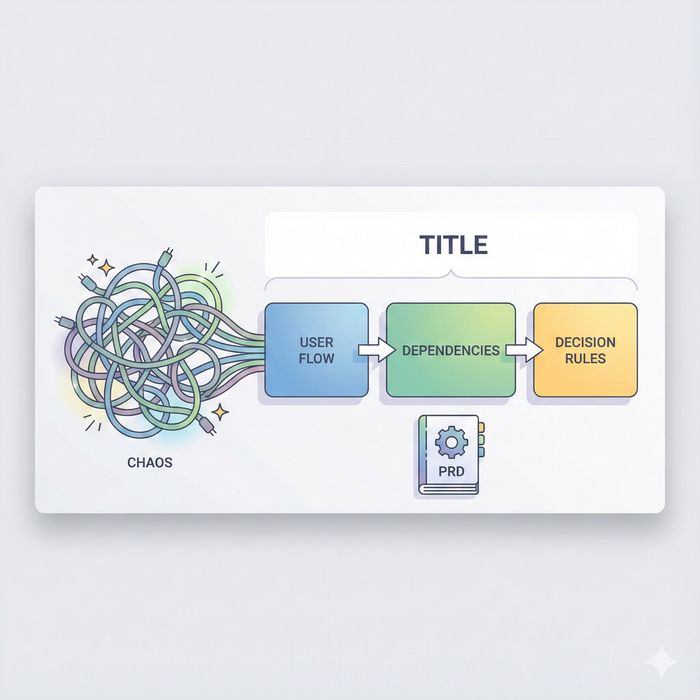
This kind of input is hard for humans to parse — and even harder for an AI. Vibe-coding AIs still generate results, but the lack of structure often causes misinterpretations, missing logic, or distorted feature intent. Stream-of-consciousness input starts fast but becomes exponentially harder to manage as the product grows.
So what changes when a PRD enters the process?
A PRD helps the AI clearly understand the user’s intent and the feature structure behind it. Because a PRD organizes the feature’s purpose, conditions, flows, and edge cases, the AI receives information in a clean logical hierarchy — not as fragmented text.
With a PRD, the AI can accurately recognize:
- Which features are core
- Which flows must happen first
- Which conditions and exceptions are non-negotiable
This drastically reduces incorrect screens, conflicting features, or missing steps. It’s not just “tidier documentation” — it fundamentally improves the speed and accuracy of AI development.
A PRD compensates for the weaknesses of vibe coding.
Vibe coding is fun and fast at the start, but the accumulated side effects — conflicting features, disjointed UX flows, missing logic — become painful over time.
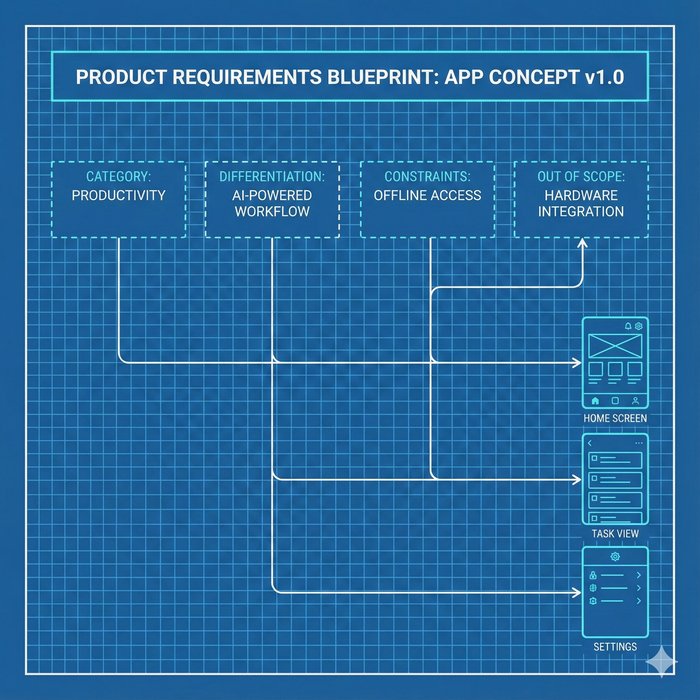
A PRD restores order. Just as a developer keeps a blueprint next to their code, teams keep the PRD open while vibe coding.
With a PRD, you always know:
- where a feature begins
- what condition leads to what screen
- how one feature connects to the next
In short, a PRD transforms intuitive creation into a structured product — and once there is structure, speed actually increases further.
Why does a PRD make AI more productive?
AI is fast, but without “context + structure,” it cannot produce accurate results. Even if a user’s prompt sounds clear to a human, the AI may misread the intent.
A PRD organizes the entire feature set logically and hierarchically — essentially becoming the blueprint the AI follows.
This reduces the time AI wastes trying to interpret messy input and allows it to focus on building precise, stable implementations. As a result, both speed and quality improve dramatically. A PRD is fundamentally a document that makes the AI perform better.
A PRD strengthens the backbone of the app.
Vibe coding is fast, but speed alone doesn’t create a stable structure. An unstructured app feels fast early on but becomes fragile and expensive to maintain later.
A PRD provides the skeleton:
- Fewer feature conflicts
- Smoother UX flows
- Faster maintenance and iteration
Fast development requires structure — and the PRD is that structure.
Conclusion — A PRD is not a slow document. The faster you build, the more you need it.
Vibe coding is a speed-oriented development style, which is exactly why a stable reference point is essential. A PRD is not something that slows you down — it protects your speed.
Even if users type in a chaotic, stream-of-consciousness style, the PRD helps the AI anchor everything into a coherent structure, producing far more reliable results.
Ultimately, a PRD turns intuitive ideas into a real, stable product. Fast development only works when a PRD is there to support it.