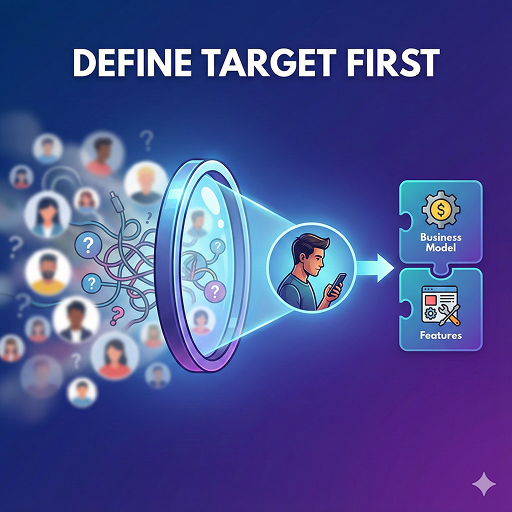
What does it really mean to define a target user?
Many teams say they have “defined their target user,” but in reality, they often remain at a very abstract level. Phrases like “office workers in their 20s–30s,” “all users,” or “an app anyone can use” do not define a target—they avoid it.
Defining a target user is not about listing age or occupation. It means clearly fixing who needs this app the most, and in what situation that person opens the app. This concrete definition is what turns an idea into a product with direction.
Decision Criteria: Who is the ‘primary user’ of this app?
The most important question when defining a target user is not “Who might use this the most?” but “Who would be most uncomfortable without this app?”
To answer that, the following criteria must be clarified at the PRD stage:
-
Problem Intensity: How critical is this problem for a specific group of users? The group experiencing the strongest discomfort becomes the core target.
-
Frequency: How often does this user encounter the problem? The more frequent it is, the more likely the app becomes a habit.
-
Alternative Level: Is the user already solving this problem well with other tools, or merely enduring it?
-
Willingness to Pay: Is the user willing to spend time or money to solve this problem? This directly connects to the business model.
Targets that fail these criteria may look attractive on paper, but rarely become users who actually sustain the product.
Comparison: The difference between apps with a clear target and vague ones
Apps with a clear target always have a decision 기준 when discussing features. A single question organizes everything: “Would this user actually use this feature in this situation?”
In contrast, apps with vague targets make every idea sound reasonable. Because it’s unclear who the app is for, there is no solid reason to reject feature requests. As a result, the app accumulates more and more features, yet becomes essential to no one.
This gap widens over time.
Outcome: The target user determines both the business model and the features
Once the target user is defined, the business model naturally follows. Whether advertising makes sense, whether subscriptions are viable, or whether one-time payments work is already determined by the user’s behavior and problem intensity.
The same applies to features. Even the same feature takes a completely different form depending on the target user.
That is why the target user must appear at the very beginning of the PRD.
The PRD should clearly define:
- A concrete description representing one core target user
- The exact situation and purpose for which this user opens the app
- Features that this user definitely does not need
When the target is fixed this way, countless decisions during development become much easier.
Summary
Defining the target user is not a marketing task—it is the starting point of product design. Only by clearly identifying who needs the app the most can the business model and features naturally narrow and solidify.
The PRD fixes this target in words so the entire team looks at the same user. The clearer the target, the less the app wavers—and the faster it reaches completion.