What marketing actually needs first is not “ideas”
When teams start app marketing, they often begin by brainstorming ideas: what copy to write, which features to highlight, which audience to target. But in reality, marketing usually breaks down not because of a lack of ideas, but because of a lack of shared criteria.
If there is no common understanding of what problem the app solves, who it is built for, and in what context it is used, marketing decisions end up relying on individual intuition rather than a clear direction.
Decision Criteria: What does “context” mean in marketing?
In marketing, context is not just background information. It includes the situations in which users think of the app, the moments when the app becomes necessary, and the reasons they choose it over existing alternatives.
When this context is not clearly defined, marketing messages tend to turn into feature lists or vague benefit statements. When context is clear, marketing shifts its focus—from “what should we say?” to “in what situation should users think of this app?”
Comparison: Marketing without a PRD vs. marketing grounded in a PRD
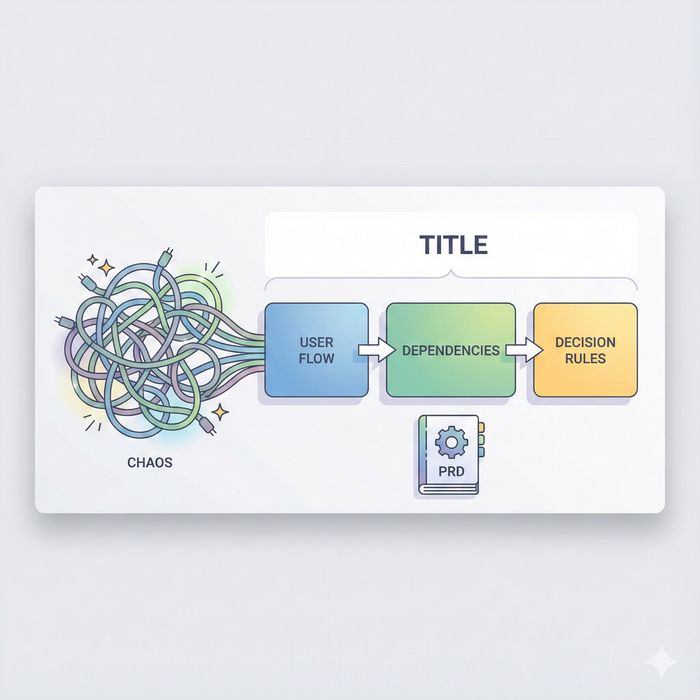
Marketing done without a PRD usually relies on fragmented inputs: feature explanations from developers, ideas raised in meetings, or competitor ads used as reference.
As a result, messages change frequently and each campaign emphasizes something different.
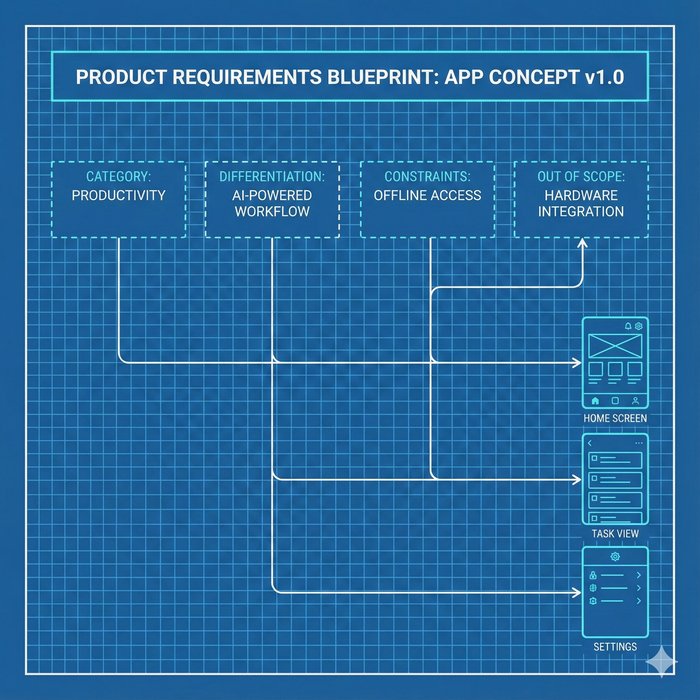
When marketing is done while referencing the PRD, the situation changes. The PRD already defines the target user, core problem, user flow, and feature priorities.
Marketers can then make clear decisions such as: “This feature is core—let’s lead with it,” or “This is a secondary feature—let’s leave it out of the message.”
Outcome: The PRD functions as a shared context document for marketing
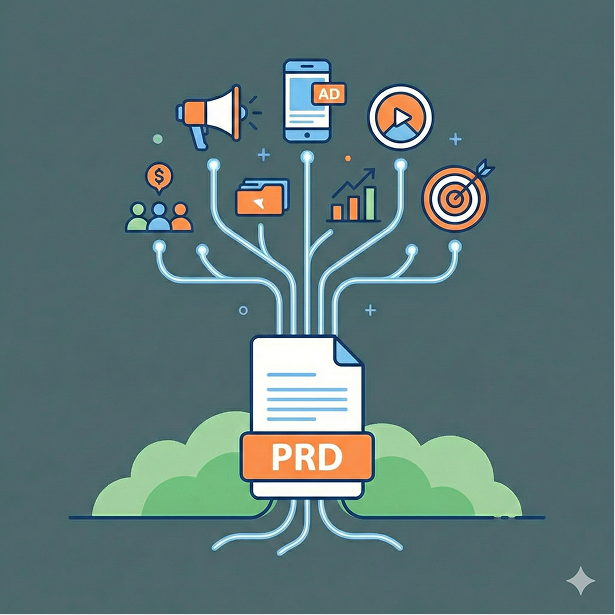
The PRD is not a marketing document. But in practice, it becomes the most important context document for marketing.
Whenever new ad copy is written, a landing page is structured, or content direction is decided, the PRD serves as the reference point. Because it clearly explains why the app exists and which flows matter most, marketing messages can remain consistent. As this consistency accumulates, users begin to perceive the app with a clear and stable image.
Conclusion: App marketing gains structure only when the PRD is part of the process
Effective app marketing does not require flashy strategies. What matters more is whether the product’s definition and context are clearly established.
The PRD may be written for development, but it also documents the full context of the app. Looking at the PRD during marketing means building messages on the same criteria and in the same direction. With this structure in place, marketing becomes stable, cumulative, and scalable.
Summary
App marketing needs criteria before ideas. While the PRD is a development document, it also captures the app’s target users, core problems, and usage context.
When marketing is grounded in the PRD, messaging stays consistent—and users gain a clear understanding of what the app is and why it exists.